
Choosing among garage sealing companies takes more than comparing a price or product name. A good decision starts with the concrete, the result you want, and a clear explanation of how the installer will prepare and treat the floor. If you are still sorting out what a sealer or coating can do, begin with this guide to concrete sealer for garage floors, then use the questions below to evaluate each proposal.
Request a garage project consultation
What does “sealing” mean for a garage floor?
Homeowners use the word “sealing” to describe different treatments. A penetrating concrete sealer is intended to enter the pores of the slab. A topical coating forms a layer over the surface. Epoxy and polyaspartic are examples of coating materials, but their systems and installation instructions are not identical. A clear sealer, floor paint, and a professionally installed multi-layer coating should not be assumed to provide the same finish or service.
Before you speak with a provider, write down what you want the floor to do. Your priorities might be reducing dust, making routine cleanup easier, choosing a particular appearance, or creating a finished surface for regular vehicle use. The priorities will shape the questions worth asking. Garage Kings offers garage floor coating services, while the exact choice for a particular slab depends on its condition and the agreed project scope.
Ask the company to name the proposed system in plain language. What material is used for each layer? Is it a penetrating product or a surface coating? What finish should you expect? What limitations should you understand before agreeing? If the answer relies only on a trade name, ask the representative to explain what that product does and how it fits your goal. You can also review this overview of epoxy garage flooring ideas as background for a conversation about finish and use.
How should a company evaluate your concrete?
A useful consultation begins with the floor, not a promise about the coating. Concrete can have cracks, old paint or sealer, oil spots, surface scaling, uneven areas, or signs that moisture may be a concern. These conditions can affect both surface preparation and the proposed work. Ask what the representative observed and how those observations change the recommendation.
- What will you inspect? Ask whether the evaluation includes cracks, previous coatings, contamination, surface wear, and visible moisture concerns.
- How will you address defects? Ask which repairs are included in the estimate, what repair method is proposed, and what remains outside the scope.
- What if you uncover an issue? Find out how concealed conditions are documented, who explains any added work, and whether you must approve a change before it begins.
- What conditions must be met before installation? Ask how the company determines whether the slab is ready and what cleaning or drying is required.
Be wary of a recommendation that sounds identical for every floor, especially if the provider has not asked about previous coatings or visible damage. The best answer is not necessarily the most elaborate system; it is a proposal that explains the relationship between the floor’s condition, your priorities, and the work being offered. Garage Kings also has an epoxy floor features guide that can help you identify points to clarify with an installer.
If you want a technical reference on concrete, the American Concrete Institute provides educational resources about concrete and its construction. Use general reference material as context, not as a substitute for an on-site evaluation or the product instructions for a specific coating system.
Which preparation steps are included?
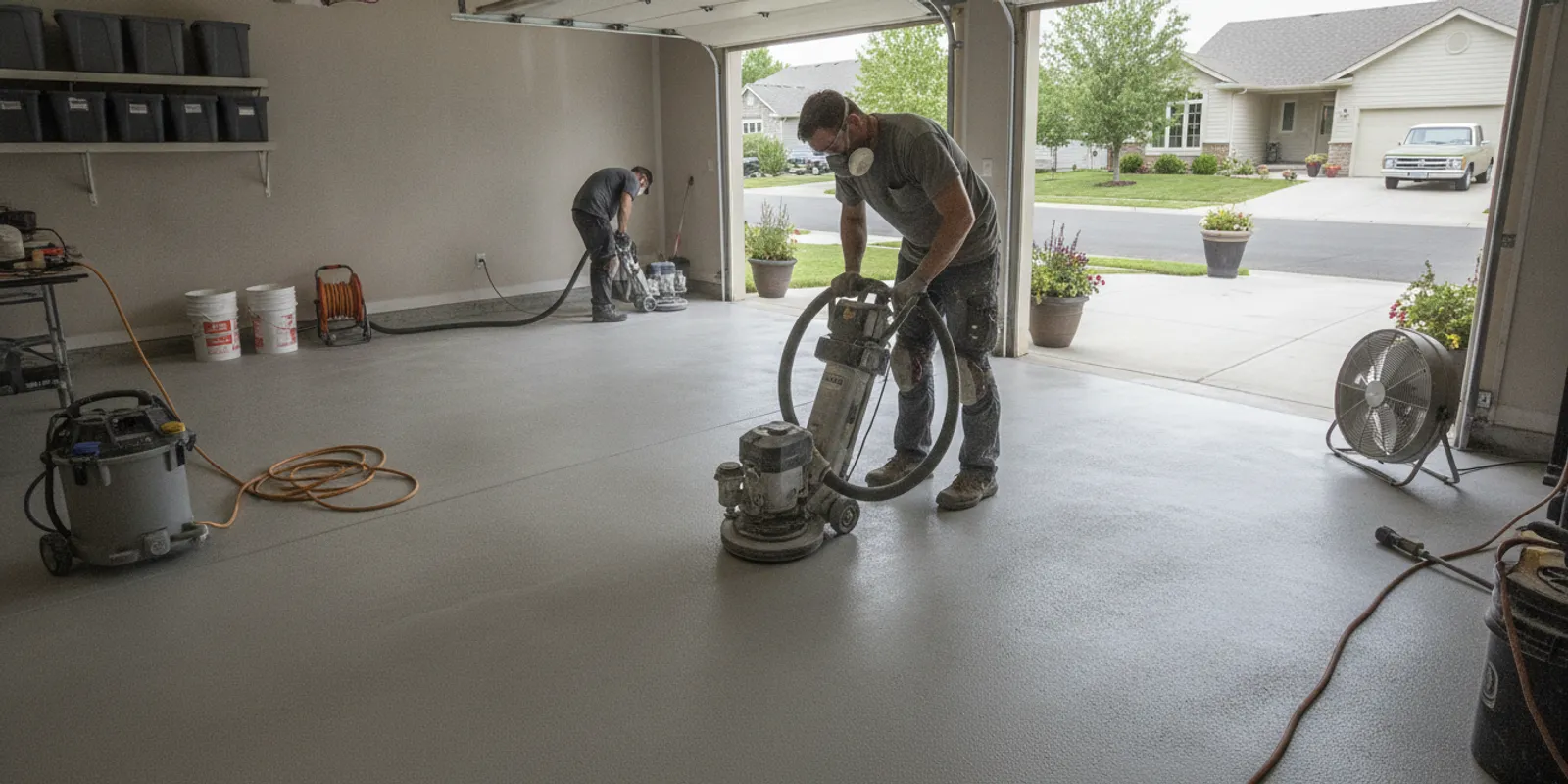
Preparation deserves a detailed conversation because the new coating must be applied to a properly prepared surface. Ask what equipment and process the crew will use, how it will address the floor’s perimeter and tight areas, and whether existing paint or coating needs removal. “We prepare the floor” is not a complete description. Request the steps in ordinary language and ask what each step is meant to accomplish.
Then compare the answer with the written estimate. Does it include cleaning, mechanical preparation, treatment of cracks, and removal of incompatible material? Are there areas that will receive a different treatment? The right steps depend on the slab and product, so look for a specific explanation for your garage rather than a universal promise.
Preparation also includes planning the work area. Ask what must be moved before the crew arrives, whether cabinets or shelving will need to be cleared, and who is responsible for moving stored items. Confirm how the work area will be protected and what cleanup is included. If flooring is one part of a larger garage plan, review the company’s garage services and discuss the order of any related work before scheduling.
What coating details should you compare?
Product labels do not tell the whole story. Two proposals using the same general material may still differ in preparation, layer design, finish, installation conditions, and care instructions. Ask each provider to list the proposed layers, explain their purpose, and identify the conditions under which the system should be installed. If a provider uses a brand or trade name, ask what material it represents and whether it refers to one layer or the complete system.
| Option or project element | Questions to ask | Why it matters |
|---|---|---|
| Penetrating concrete sealer | Does it enter the concrete or form a surface film? What appearance and protection are intended? | It may fit a different goal than a decorative, film-forming coating. |
| Epoxy coating system | Which layers are included? What surface preparation and cure conditions does the system require? | The word “epoxy” can refer to different products and project scopes. |
| Polyaspartic coating system | Which layers are specified? How do site and temperature conditions affect the installation plan? | The full system and its application process matter, not the label alone. |
| Concrete repair or surface work | Which cracks and defects are included, and which are excluded? | Clear boundaries set expectations and help prevent surprise changes. |
| Warranty and care | What is covered, for how long, and what exclusions or care rules apply? | Written terms show the actual support being offered. |
Use the table to compare offers line by line, not to choose a product based on a single feature. A lower estimate may reflect a smaller work area, a different system, less preparation, excluded repairs, or a different warranty. Ask the provider to explain those differences before treating the totals as comparable. For additional care questions, consult this garage floor care guide and confirm that its advice applies to the system being proposed.
How can you compare estimates fairly?
Request a written scope that identifies the measured work area, preparation, materials or system, each layer’s purpose, repairs, cleanup, and expected schedule. The estimate should also state payment terms, relevant exclusions, warranty documentation, and how a change in conditions will be handled. Project costs vary with the size and condition of the floor, the selected system, and the work required, so a total without a matching scope is difficult to evaluate.
Make a comparison sheet with one column for each company and a row for each item. Mark an item “included,” “excluded,” or “not clear” instead of filling gaps with assumptions. Then ask every provider the same follow-up questions:
- Does the proposal state the area to be treated?
- Are preparation and repair tasks described separately?
- Does it identify the coating system and the purpose of its layers?
- Are optional work, exclusions, and possible added costs explained?
- Who clears the floor, protects nearby items, and handles cleanup?
- Does the plan state when the surface can be walked on and when vehicles can return?
- Are warranty terms, care instructions, and contact details documented?
For example, imagine one estimate lists a coating but says little about repairs, while another lists preparation, crack treatment, coating layers, and what happens if more work is needed. The second estimate may be easier to assess even if its total is higher. You still need to decide whether its scope matches your goals and budget; detail alone does not make a proposal the right choice. Photos in the project gallery can help you discuss finish preferences, but they do not replace written specifications for your own floor.
What warranty questions should you ask?
Ask to read the warranty before signing, not after the floor is installed. Confirm the length of coverage, what kinds of problems it addresses, whether coverage applies to the product, installation, or both, and how a claim is submitted. Ask who reviews the concern and whether there are conditions that may limit coverage.
Clarify how the warranty treats normal wear, impact, exposure to particular substances, or changes in the concrete. Ask whether cleaning products or maintenance routines affect coverage. Do not assume a long term means every possible problem is included. What matters is the written language and whether the provider can explain it clearly.
Keep the signed scope, warranty, product information, care instructions, and any written changes together after installation. If a representative makes a verbal statement about coverage, ask for it to be reflected in the documents. This gives you a useful record of what was proposed and what was agreed.
What should you ask about installation day?
Confirm who will perform the work, what areas need to be accessible, and how your household should prepare. Ask how long the work is expected to take and when the surface can be walked on or used for vehicles. Timing can vary with the coating system and site conditions, so follow the installer’s project-specific instructions rather than assuming a standard wait time.
Ask whether temperature, weather, or ventilation affects the schedule. Establish how the crew will communicate a delay and who your point of contact will be during the project. Confirm whether the estimate includes moving items, masking adjacent surfaces, and removing job debris. A clear plan helps you avoid last-minute questions about access or use.
Think about the order of any other garage work. If you are also considering storage, discuss whether flooring should be completed before cabinets or other equipment are installed. Garage Kings lists garage cabinet options as a separate service, and asking about sequencing can help you plan a coordinated project without assuming that every task is included in a floor estimate.
How do you assess whether a company is a good fit?
Look for clear answers, a specific written scope, and a willingness to explain trade-offs. Ask who will be responsible for the project, how the crew’s experience relates to the proposed system, and whom you should contact after the work. Verify that the company serves your location and that its proposed scope reflects the conditions discussed during the evaluation. The Garage Kings locations directory can help you check service-area information.
Pay attention to how the provider handles questions it cannot answer immediately. A careful company should be able to explain what needs further review rather than making a guarantee before it understands the floor. Avoid relying on unsupported promises about performance, a perfect appearance, or a specific lifespan. Instead, compare documented expectations and ask what the system can and cannot address.
Check that the proposed work matches your goal. A decorative finish may call for a different conversation from a simple treatment intended to reduce dust. If the concrete has unusual damage or moisture concerns, ask whether further evaluation is needed before installation. The company overview offers background on Garage Kings, while its garage makeover guide can help you think through whether flooring is one element of a broader plan.
What should you do before signing?
Take a short pause between receiving an estimate and approving the work. Read the document from top to bottom and circle phrases that could be interpreted in more than one way. “Repair as needed,” “standard preparation,” or “final finish” may need a more exact explanation. Ask the provider to revise unclear wording so that the scope says what will happen and what is not included.
Make sure names, dates, areas, and any selected finish are correct. Check that the promised schedule and return-to-use instructions are consistent with what the representative explained. If an estimate changes after an inspection, ask what changed and why. Keep an updated copy of the approved scope rather than relying on an earlier draft or a text message alone.
Finally, compare fit, not just price. A suitable provider should listen to how you use the garage, explain reasonable options, document the agreed work, and make it easy to understand the next step. You can review the broader Garage Kings service overview or ask a local representative to clarify how a proposed floor project would be scoped.
Discuss your garage floor project
Frequently Asked Questions
Is garage sealing the same as garage floor coating?
Not always. “Sealing” may refer to a penetrating treatment or to a topical coating. Ask the provider to identify the specific product, explain how it is applied, and describe the result it is intended to provide on your concrete.
Should I choose epoxy or polyaspartic?
There is no universal answer for every garage. Compare the complete system, preparation requirements, installation conditions, appearance, care instructions, and written warranty against your floor’s condition and the way you use the space.
Can a coating cover cracks in my concrete?
Some cracks may need to be treated before a coating is applied. A coating should not be assumed to correct structural movement or every concrete problem. Ask the installer to assess the cracks, describe any proposed repair, and state what will remain outside the project scope.
How many estimates should I get?
There is no set number that fits every project. Seek enough detailed proposals to compare preparation, system, repair allowances, warranty, and communication. If estimates describe different work, request clarification before comparing their totals.
Choose based on the process, not just the pitch
The right garage sealing company for your project is one that evaluates the concrete, explains its preparation and coating choices, and records the complete scope and warranty in writing. Compare those details against your priorities, and ask for clarification wherever the proposal leaves room for guesswork. That process can help you choose a plan that fits your garage and set realistic expectations before work begins.