
Garage cabinets do more than hide clutter. The right system should make tools, sports equipment, seasonal items, and automotive supplies easier to reach while fitting the way your household uses the garage. That makes brand selection about more than appearance or a quick retail comparison.
A useful garage cabinet brands comparison looks at construction, moisture resistance, capacity, layout flexibility, installation, warranty support, and who is responsible for measuring and securing the system. Retail cabinets can suit a straightforward self-install project, while professional-grade storage may be the better fit for a measured, integrated transformation.
Start by defining what the cabinets must hold, where they can go, and how much installation responsibility you want to take on. Reviewing garage cabinet types and benefits can help establish the basics before you compare brands and service models.
Schedule a free in-home consultation to explore a garage storage plan with Garage Kings.
From there, the most important questions concern the brand behind the system and the details that determine whether it performs well in your space.
What to Look for in a Garage Cabinet Brand
The right cabinet brand should solve the way your household actually uses the garage, not simply fill an empty wall. Start by listing what needs to be stored, including tools, sports equipment, lawn supplies, automotive products, seasonal decorations, and household overflow. Note which items need daily access, which are bulky, and which should stay secured. This use-based inventory gives you a practical standard for comparing designs.
Next, evaluate the following criteria before choosing a system:
- Measurements and access: Account for vehicles, doors, windows, outlets, steps, and walking paths. A cabinet layout should use available wall space without making parking or everyday movement harder.
- Cabinet format: Decide whether wall-mounted cabinets, base cabinets, drawers, workbenches, or a workstation best fit your routine. A combination can separate frequently used tools from seasonal or hazardous supplies.
- Customization: Ask whether the brand offers modular components, adjustable storage, tool organization, locks, slatwall integration, and finishes that work together. Custom planning matters when the garage has unusual dimensions or several storage zones.
- Materials and moisture: Verify the cabinet construction, finish, hardware, and moisture-resistant features. Garages can experience temperature changes, humidity, dirt, and spills, so the product should suit the conditions in your region and intended use.
- Security and durability: Check locking options, drawer construction, hinges, and the stated capacity for each component. Do not assume that every cabinet in a product line has the same load rating or performance.
- Installation responsibility: Clarify who measures the space, handles wall mounting, works around obstacles, and removes packaging. Ask how the installer will secure wall-mounted units and confirm the expected project scope before work begins.
- Warranty and support: Read what the warranty covers, who handles service questions, and whether support continues after installation. Local execution backed by established supplier relationships can be useful when a project requires planning, follow-up, or replacement parts.
For a foundation-level review of garage cabinet types and benefits, compare the available formats before comparing brand names. A strong comparison matches the system to your storage needs, measurements, installation expectations, and desired level of customization. That matters more than choosing the cabinet with the most features on a product page.
Which Garage Cabinet Materials Hold Up Best?
Material choice affects how a cabinet handles moisture, daily wear, cleaning, and the kind of items you store. There is no single material that is best for every garage. A cabinet for light household overflow has different demands than one used for power tools, automotive supplies, or heavy equipment.
Steel is a common choice when durability and a more substantial feel matter. It suits homeowners who want enclosed storage for tools and equipment, particularly when the system also includes drawers, work surfaces, or locking doors. Look beyond the word “steel” in a product description. Check the frame and panel construction, hardware, shelf design, and finish. A powder-coated finish can provide a clean appearance and make routine wiping easier.
A moisture-resistant design is worth prioritizing in garages exposed to humidity, wet vehicles, or seasonal temperature changes.
Aluminum offers another metal option. It can provide a durable cabinet structure with less weight than many steel systems, which may matter during delivery, installation, or future reconfiguration. Its usefulness depends on the rest of the construction, including hinges, drawer slides, shelves, and mounting hardware. Compare the complete cabinet rather than assuming that a lighter cabinet is automatically stronger or weaker.
Resin and other plastic-based cabinets are practical for homeowners who want rust-resistant storage for general supplies. They can be a sensible choice for lawn products, cleaning items, sports equipment, or seasonal belongings, especially when the cabinet will remain freestanding. Inspect the door alignment, hinges, shelving, and cleaning requirements. Resin avoids rust, but that does not make every resin cabinet suitable for heavy tools or high-load applications.
Wood can be budget-friendly and can bring a warmer, furniture-like appearance to a garage. It may work well in a dry, finished space where appearance is a priority and the stored items are not excessively heavy. Moisture exposure, edge protection, surface finish, and cleaning methods deserve close attention before choosing it for an unconditioned garage.
A useful materials comparison from Car and Driver identifies steel, aluminum, resin, and wood as common garage cabinet materials, with different tradeoffs in durability, rust resistance, and cost positioning. For your own choice, start with the environment and the contents: choose the construction that matches moisture exposure, load needs, maintenance expectations, and the finished look you want. Then verify the manufacturer’s specifications instead of relying on the material label alone.
How Do Garage Cabinet Brands Compare on Fit and Capacity?
Fit is more than choosing a cabinet that technically fits against a wall. Compare the full layout: available width, door and vehicle clearance, cabinet depth, shelf adjustment, and how the system handles corners or other fixed features. Many garage cabinet systems are modular, allowing homeowners to combine different sizes, adjust shelves, and build across an entire wall instead of relying on one freestanding unit. Practical garage storage solutions start with matching each zone to what you need to store.
Wall-Mounted And Floor Cabinets Solve Different Problems
Floor cabinets provide a stable base for heavier equipment and can support a work surface or workstation. They also occupy floor area, so measure walkways, vehicle doors, and the space needed to open cabinet doors fully. Wall-mounted cabinets preserve usable floor space and can keep tools, chemicals, or seasonal items above the garage floor. However, their performance depends on the mounting method and the wall structure, not just the cabinet material. Car and Driver notes that a wall cabinet must be mounted correctly into wall studs, because even a strongly built cabinet can fail when its anchoring is inadequate: tested garage cabinet comparisons.
Capacity Ratings Are Product-Specific
Do not treat one brand’s load rating as a universal standard. In Car and Driver’s tested examples, garage cabinet ratings ranged from 50 to around 600 pounds. That wide spread reflects differences in cabinet type, shelf design, and intended use. Check whether a rating applies to the entire cabinet, one shelf, a drawer, or a locker, and ask whether it assumes evenly distributed weight.
Manufacturer specifications can vary substantially even within one product family. NewAge’s Pro Series product page advertises cabinets up to 24 inches deep and locker capacity up to 1,000 pounds. While another NewAge series lists cabinets up to 18 inches deep and locker capacity up to 800 pounds. Those are series-specific claims, not promises for every NewAge cabinet. The same page also presents different configuration counts and steel-frame specifications by series. Verify the exact model, dimensions, mounting requirements, and rating before comparing it with another system.
Measure For Access, Not Just Storage Volume
Deeper cabinets may hold more, but they can reduce clearance in a narrow garage and make items at the back harder to reach. A well-planned combination of shallow wall cabinets, deeper base cabinets, drawers, and open work areas often provides better daily access than maximizing cubic volume. Consider the weight and frequency of each item: place frequently used hand tools where they are easy to reach. Reserve larger lockers for bulky seasonal equipment, and keep heavy loads in appropriately supported base units. The best comparison is the one that accounts for your actual walls, habits, and installation conditions.
How Does a Garage Cabinet Brands Comparison Guide Your Choice?
Retail cabinets can be a practical choice when you need a few storage units and are comfortable measuring, assembling, and installing them yourself. Professional-grade systems take a more coordinated approach, with planning, product selection, installation, and support treated as parts of the same project. Neither model is automatically right for every garage. The better choice depends on how much customization your space needs and how involved you want to be.
| Consideration | Retail purchase | Professional-grade system |
|---|---|---|
| Purchase model | Select individual cabinets or a packaged set for self-directed planning. | Plan the layout with a specialist around your garage, storage goals, and available space. |
| Customization | Choose from the sizes, components, and configurations offered in a product series. | Coordinate wall cabinets, base cabinets, drawers, workstations, workbenches, locks, and slatwall elements into one layout. |
| Materials and specifications | Compare the construction, finish, depth, shelf capacity, and warranty for each series. | Match material and features to the garage environment and intended use, with project specifications confirmed during planning. |
| Measurement and installation | Verify clearances, locate studs, assemble the units, and complete mounting yourself. | Use measured planning and professional installation, including attention to fit, access, and anchoring requirements. |
| Support | Rely primarily on the retailer or manufacturer for product guidance and warranty service. | Work with a local installation team backed by supplier relationships, training, certification, and warranty support. |
Product specifications can vary substantially by series, even within the same brand. For example, NewAge product pages advertise different configuration counts, cabinet depths, steel frames, load ratings, and warranty terms across its Pro, Bold, and Bold XL lines. Those are series-specific product claims, not a blanket specification for every cabinet sold by the brand. Review the exact technical documentation for the model you are considering at NewAge’s garage storage cabinet information.
That same caution applies to any retail comparison. Check whether the stated capacity applies to a shelf, drawer, locker, or complete cabinet. Wall-mounted capacity also depends on the mounting method and whether the cabinet is correctly secured to wall studs, as testing guidance from Car and Driver’s garage cabinet review explains.
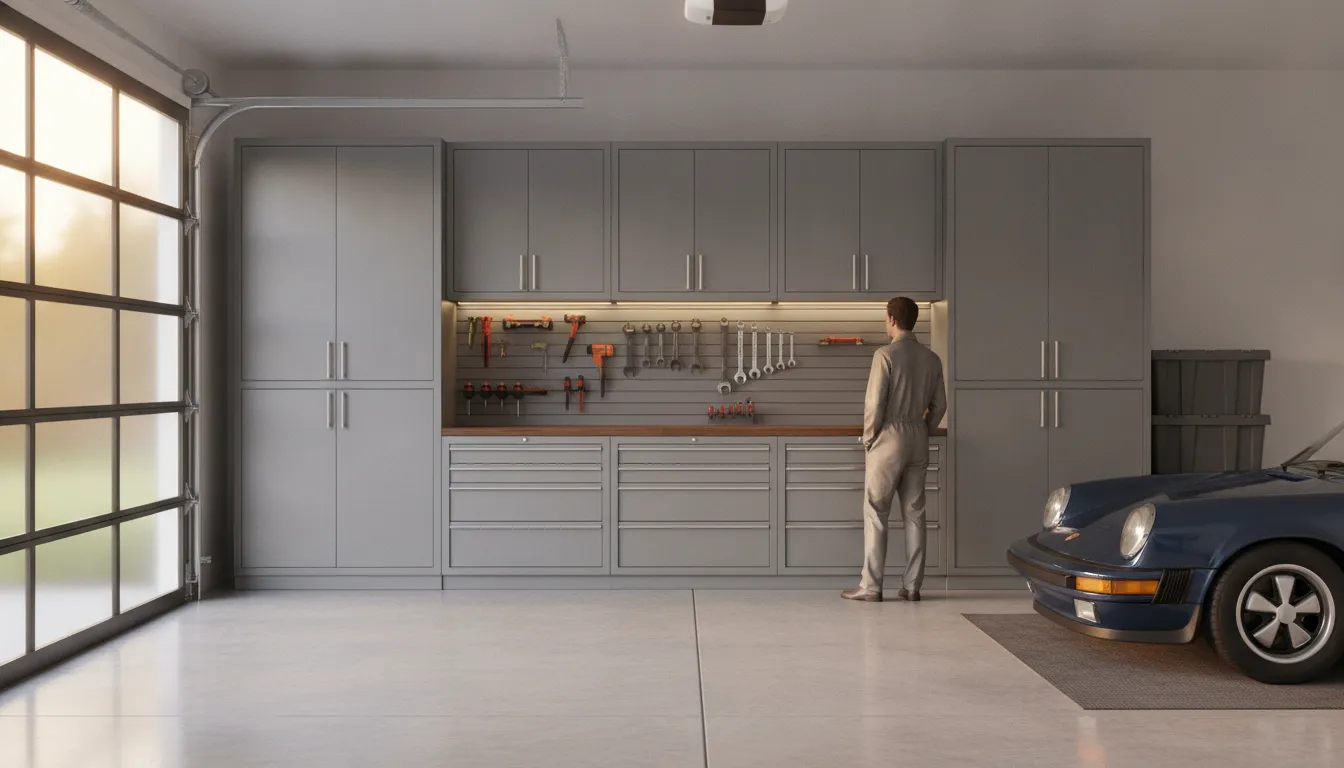
A professional system is especially useful when the garage must accommodate uneven walls, tight vehicle clearances, mixed-height equipment, or several storage zones. Garage Kings uses in-home consultations and 3D visualization to plan custom modular steel systems. The layout can combine cabinets, work surfaces, tool storage, and other elements. Retail units may still be the sensible fit for a straightforward, self-installed project. The key is to compare the complete ownership experience, not just the cabinet appearance.
Installation, Warranty, and Support
A cabinet system is only as useful as the process behind it. Before choosing a brand, ask who measures the garage and who handles delivery. Confirm who installs the cabinets and what happens if a door, drawer, or mounting component needs attention later. These details can matter as much as the cabinet material or finish.
Start by confirming what installation includes. Does the installer assemble the cabinets, level the system, secure wall-mounted pieces, and account for garage conditions such as uneven floors, finished walls, outlets, and vehicle clearance? Ask whether anchoring is included and what mounting surface is required. Wall storage must be attached correctly to appropriate structural support, not simply fastened to a surface that cannot carry the load. Also verify whether old shelving, stored items, or other obstructions must be removed before the crew arrives.
Timing deserves the same level of clarity. Most Garage Kings cabinet installations are completed in one day, but the actual schedule depends on the configuration, garage size, access, preparation, and site conditions. A professional consultation should establish the expected sequence rather than treating one-day installation as a guarantee for every project. For more detail on the variables that shape an installation, review these professional cabinet installation factors.
Warranty questions should be specific. Ask what components and finishes are covered, how long coverage lasts, whether labor is included, and which situations are excluded. Clarify who receives the service request and whether the local installer or the manufacturer handles the next step. Do not assume that two brands offer equivalent protection simply because both advertise a warranty.
Garage Kings combines local service with national backing. Local franchise teams guide the consultation and execute the project, while the broader franchise model provides supplier relationships, training, certification systems, warranty backing, and shared quality standards. That structure gives homeowners a nearby point of contact without giving up the resources of a national network. During the consultation, discuss the complete plan, including cabinet layout, anchoring, installation expectations, warranty documentation, and post-install support. A clear answer to each question is a stronger buying signal than a vague promise of service.
What Is the Best Garage Cabinet Brand for Your Home?
The right choice depends less on a universal brand winner and more on how you use the garage. Start by listing what needs to be stored, how often you access it, and whether the goal is simple containment or a complete improvement to the space. Tools and automotive supplies may call for durable cabinets and drawers. Sports equipment, seasonal decorations, and household overflow may benefit from a combination of enclosed storage, open access, and wall organization.
Choose Retail or DIY Storage When Simplicity Is the Priority
Retail cabinets can make sense when you have a straightforward layout, standard dimensions fit the available wall, and you are comfortable handling assembly and installation. This route gives homeowners control over product selection and project timing. Before buying, verify the cabinet dimensions, material, finish, capacity, mounting requirements, and replacement-part support. A cabinet that looks suitable online may not work well once door swing, vehicle clearance, outlets, and walkways are considered.
DIY systems also place more responsibility on the homeowner. You may need to measure accurately, locate suitable mounting points, level each unit, and coordinate several components. If the garage has uneven walls, limited clearance. Or a layout that needs to work around vehicles and work areas, a modular kit may require more planning than expected.
Choose Professional-Grade Storage When the Garage Needs a Plan
A professionally planned system is often the better fit when you want storage designed around the room rather than added to it. Garage Kings plans custom modular steel storage with options such as wall-mounted and base cabinets, workstations, workbenches, tool storage, locking features, drawers, and slatwall integration. The design process can account for the items you own, how you move through the garage, and how the storage should work with the rest of the transformation.
Professional installation can also simplify decisions about fit, anchoring, alignment, and the relationship between storage and other improvements. Garage Kings combines local consultation and project execution with national supplier relationships, training, certification, warranty backing, and quality standards. Specifications still vary by project, so ask what materials, hardware, installation coverage, and support apply to your system.
In this practical garage storage solutions framework, the strongest option is the one that matches your storage goals, available space, installation preference, and desired level of transformation. For some homeowners, that is a focused cabinet purchase. For others, it is a coordinated plan that combines cabinets with flooring and garage door services for a more complete result.
Frequently Asked Questions
What should I compare when reviewing garage cabinet brands?
Compare construction materials, cabinet dimensions, mounting options, usable capacity, finish quality, locking features, accessories, warranty terms, and installation support. Also consider whether the system can accommodate tools, sports equipment, seasonal items, and household overflow as your needs change.
Are retail garage cabinets a good choice for homeowners?
They can be a practical choice for a simple, budget-conscious project when you are comfortable measuring, assembling, and installing the cabinets yourself. Review the product specifications carefully, especially the materials, load limits, mounting requirements, and return policy. Retail systems may be less suitable when the garage has unusual dimensions or requires an integrated layout.
What makes professional-grade garage storage different?
Professional-grade storage typically begins with measured planning and may combine wall cabinets, base cabinets, work surfaces, drawers, tool storage, and slatwall components. A professional installer can account for wall conditions, clearance, access, and the way each area will be used. Garage Kings also uses 3D design visualization to help homeowners review a proposed layout before installation.
How long does garage cabinet installation take?
Many Garage Kings cabinet installations are completed in one day, but the actual schedule depends on the project scope, garage condition, configuration, and site access. Ask the installer what preparation is included and whether flooring, wall repairs, electrical work, or other changes require separate scheduling.
Should I choose cabinets based on brand name alone?
No. The best choice depends on fit, materials, capacity, installation responsibility, support, and the level of customization your garage requires. Compare the complete system and service experience rather than relying on a brand name or a single advertised feature.
Schedule Your Garage Storage Consultation
Choosing between retail cabinets and a professional-grade system depends on your space, storage needs, and how much planning you want to handle yourself. A personalized review can help you compare cabinet options and map out a system that fits your garage. Schedule a free, no-obligation in-home consultation with Garage Kings to discuss your storage goals and plan the next step.