
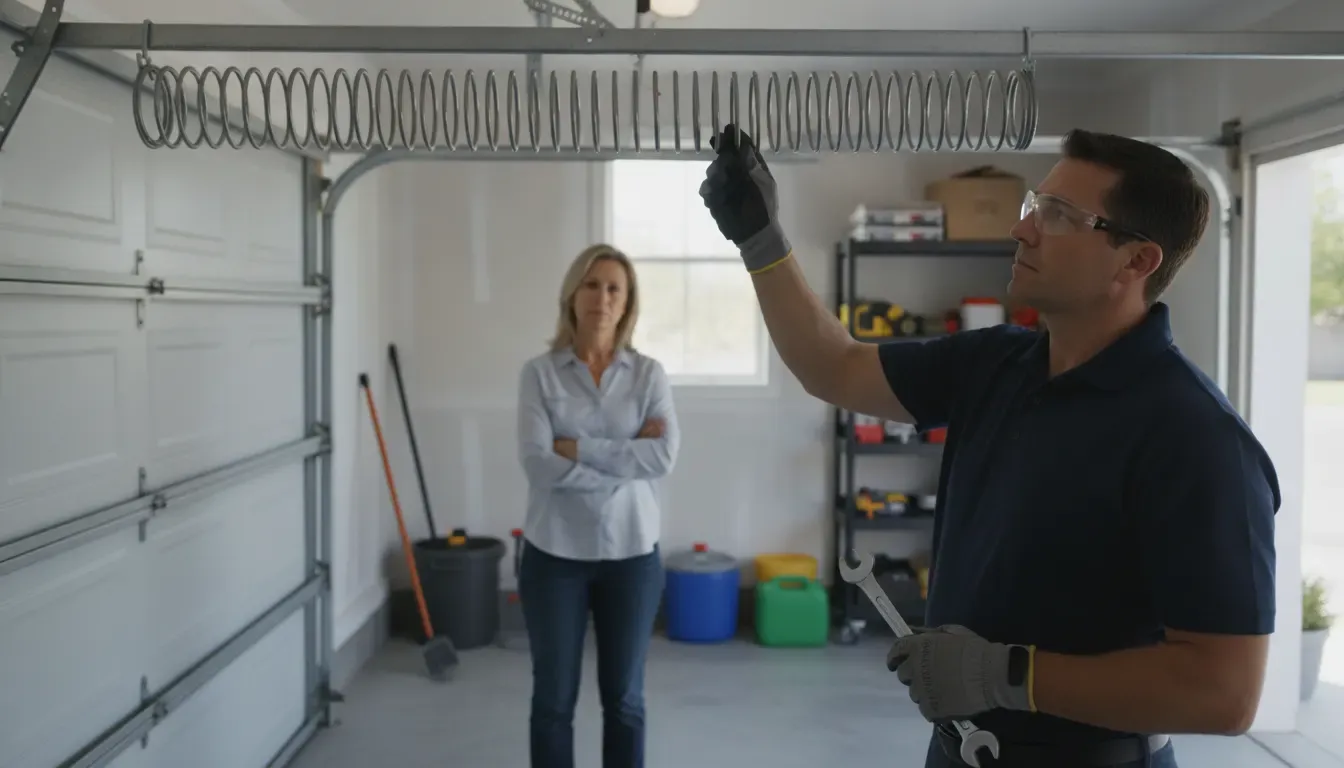
Garage door springs counterbalance the weight of the door so the panels can move safely and smoothly. When a spring is worn, broken, or incorrectly matched, the door may become heavy, uneven, noisy, or unsafe. This practical guide explains the main spring types, the warning signs homeowners can observe, and the safest next step for service.
Contact Garage Kings to arrange a professional garage door spring evaluation.
What Do Garage Door Springs Do?
Garage door springs store and release mechanical energy to counterbalance the door. That support reduces the load on the opener and lets a trained technician set the door to move in a controlled way. Springs work as part of a complete system that also includes cables, drums or pulleys, rollers, tracks, hinges, brackets, and the opener.
A spring does not lift the door by itself in isolation. It works with the other hardware while the door travels through its opening cycle. If one part is damaged or out of balance, the door can place extra strain on other components. That is why a spring symptom deserves more than a quick adjustment to the opener.
- Counterbalance: Springs offset much of the door’s weight during opening and closing.
- Controlled movement: The spring system works with cables and hardware to keep the door traveling along its tracks.
- Opener support: A correctly balanced door helps the opener perform its intended job instead of trying to lift an improperly supported load.
- Safety dependence: Springs, cables, brackets, and related hardware can store or carry significant force, so repairs require the correct tools and training.
Garage Kings describes garage doors as a complete system, with professional repair, service, installation, and maintenance available at participating locations. The Garage Kings garage door service page also identifies broken springs as a reason to schedule an appointment, which is the appropriate response when a homeowner cannot safely identify the fault.
What Are The Main Types Of Garage Door Springs?
Residential garage doors most commonly use torsion springs or extension springs. Both types help counterbalance the door, but they are mounted and loaded differently. A homeowner can often identify the general arrangement from a safe distance, but the appearance alone is not enough to select a replacement spring or approve a repair.
| Feature | Torsion Springs | Extension Springs |
|---|---|---|
| Typical location | Mounted on a stationary shaft above the door opening | Mounted alongside the horizontal tracks |
| How force is stored | The coiled spring twists around a shaft | The spring stretches and contracts as the door moves |
| Related hardware | Winding components, drums, shaft, and lift cables | Pulleys, lift cables, and safety cables |
| Homeowner priority | Do not touch winding hardware or attempt adjustment | Confirm that safety cables are present, then request service for damage or imbalance |
Torsion Springs
Torsion springs sit above the door, usually on a shaft that runs across the opening. As the door moves, the springs wind or unwind and transfer force through drums and cables. This arrangement can look compact and orderly, but the stored energy remains a serious hazard when the spring or its hardware is damaged.
Extension Springs
Extension springs run beside the horizontal tracks and extend as the door travels. Because of their position, they should have safety cables that pass through the springs and secure to the surrounding structure. The Door and Access Systems Manufacturers Association, or DASMA, advises homeowners to call a local dealer for a safety inspection if extension springs do not have safety cables.
The type of spring is only one part of the diagnosis. Door weight, height, track arrangement, cable routing, spring dimensions, and the condition of the surrounding hardware all matter. Never use a spring from another door as a visual or dimensional shortcut.
What Are The Warning Signs Of A Garage Door Spring Problem?
Common garage door spring warning signs include a door that feels unusually heavy, will not stay open, moves unevenly, makes a new scraping or snapping sound, or stops working after a loud pop. These signs can also involve cables, tracks, rollers, hinges, or the opener, so treat them as reasons to stop and arrange an inspection, not as a diagnosis.
- The door becomes heavy: If the door is suddenly difficult to lift manually, the counterbalance system may not be supporting it correctly.
- The door will not stay open: A door that drifts down or closes after being opened may be out of balance.
- The door opens unevenly: One side that rises faster or hangs lower can indicate a spring, cable, drum, or track issue.
- A loud snap occurs: A sudden bang from the garage can happen when a spring breaks. Do not continue cycling the door to see whether it still works.
- There is a visible gap in a coil: A separated torsion coil can be a clear sign of a broken spring, but do not approach it to confirm the condition.
- Cables appear loose or displaced: A spring problem can affect cable tension and alignment. Frayed or worn cables need trained service.
- The opener strains or reverses: A motor that struggles with a door that previously moved normally may be reacting to a balance or hardware problem.
Do not rely on sound alone. DASMA notes that springs can squeak during normal use, while persistent noise can warrant professional service. A quiet spring can still be worn, and a noisy spring is not automatically broken. The useful pattern is a change in movement, balance, or safe operation.
Can You Check Garage Door Springs Yourself?
Homeowners can perform a limited visual and operational check from a safe position, but spring repair is not a DIY maintenance task. Do not loosen fasteners, insert bars into winding cones, remove cables, stretch extension springs, or attempt to replace a spring. The safest homeowner check gathers information for a technician without touching the loaded hardware.
- Look from outside the spring path for an obvious broken coil or a visibly displaced cable.
- Observe whether the door is crooked, unusually heavy, or unable to remain open.
- Keep children, pets, and vehicles away from a door that is stuck or unstable.
- Do not repeatedly activate the opener when the door is heavy, crooked, jammed, or partially open.
- Do not stand beneath a raised door that cannot be confirmed as stable.
- Write down what changed, including any snap, grinding sound, failed opening, or uneven travel.
Disconnecting an opener and lifting a door by hand is not a routine test for every situation. A trained professional can decide whether a controlled balance test is safe and can secure the door before inspecting the spring system. DASMA specifically describes spring systems as dangerous and recommends trained professionals for repair.
See Garage Kings garage door repair and maintenance services.
Why Are Garage Door Spring Repairs Dangerous?
Garage door springs and cables can store or transmit substantial force. If a winding component, bracket, cable, or spring fails while someone is working on it, the hardware can move suddenly. The danger is not limited to the coil itself. A repair can affect the door’s balance, the cable path, the tracks, and the opener’s operation.
DASMA’s safety guidance recommends professional inspection of old or worn springs, replacement of both springs when a door uses a pair, and trained service for worn or frayed cables. Its guidance also says installation and major repair work should be performed by trained technicians and follow the manufacturer’s instructions.
These precautions apply even when the door seems familiar. Different doors use different spring sizes, lift arrangements, brackets, and safety components. A spring that looks similar may not carry the same load. A replacement that is too weak, too strong, or incorrectly installed can leave the door unsafe and can accelerate wear in other parts.
What To Do If A Spring Breaks
- Stop operating the door and keep people away from the opening.
- Do not pull the emergency release unless a trained professional has confirmed that doing so is safe for the door’s position.
- Do not remove a broken spring, cable, bracket, or track hardware.
- If the door is open, do not stand under it or try to force it closed.
- Contact a qualified garage door service provider and describe what happened.
A professional inspection should look beyond the broken spring. The technician may need to assess the cables, drums or pulleys, bearings, rollers, hinges, tracks, brackets, opener, and door balance. The goal is a safe, correctly matched repair rather than replacing one visible part while leaving a related hazard in place.
How Can You Help Garage Door Springs Last Longer?
Spring wear depends on how often the door cycles, the door’s weight, the environment, the condition of the other hardware, and the quality of installation and maintenance. No maintenance routine can guarantee a particular service life. The practical goal is to reduce avoidable strain and identify changes before a small issue becomes an unsafe failure.
- Schedule periodic inspection: A trained technician can evaluate balance, cables, mounting points, and related hardware.
- Keep the door and tracks clear: Objects in the travel path can cause impact, binding, or an uneven load.
- Use the recommended lubricant: DASMA notes that a suitable spray lubricant may help with squeaky springs, while persistent noise should be evaluated.
- Do not overload the door: Added weight, unapproved attachments, or damaged panels can change the counterbalance requirement.
- Respond to new symptoms: Heavy lifting, uneven travel, loose cables, or a door that will not stay open should not be ignored.
- Replace paired springs appropriately: When a door uses two springs, DASMA advises replacing both when service is needed so the system remains consistent.
Maintenance is also a good time to review the entire garage door system. Garage Kings offers garage door repair, service, installation, and maintenance through participating locations. Use the Garage Kings contact page to find the appropriate local team.
Should You Repair The Spring Or Replace The Garage Door?
A broken spring does not automatically mean the entire garage door needs replacement. Repair is often a reasonable path when the door is structurally sound and the problem is limited to a serviceable component. Replacement may deserve discussion when the door has repeated failures, structural damage, widespread corrosion, outdated safety features, or performance goals that the existing system cannot meet.
| Situation | Likely conversation | What to evaluate |
|---|---|---|
| One spring has failed and the door is otherwise sound | Professional spring-system repair | Paired springs, cables, balance, drums or pulleys, and door condition |
| The door has recurring failures | Repair versus replacement review | Age, panels, tracks, hardware, opener, and total repair history |
| The door has structural damage or severe corrosion | Replacement consultation | Safety, fit, insulation, material, style, and installation requirements |
| The opener and door both struggle | Complete-system assessment | Balance, motor load, door weight, safety reversal, and compatibility |
Keep the spring question separate from the broader garage door buying decision. Garage Kings’ garage door installation and replacement guide covers materials, styles, insulation, and replacement planning. This spring guide is narrower: it helps you recognize counterbalance concerns and choose a safe service path.
What Should You Ask A Garage Door Spring Technician?
A clear service conversation helps a homeowner understand what failed and what the repair includes. Ask the technician to explain the condition of the complete counterbalance system, not just the most visible component. The answers should be specific to the door and supported by a safe inspection.
- Which spring system does my door use, torsion or extension?
- What evidence shows that the spring is broken, worn, or out of balance?
- Are the lift cables, drums, pulleys, bearings, brackets, rollers, and tracks safe?
- If the door uses two springs, should both be replaced during the same service?
- Does the door remain structurally sound, or are there replacement concerns?
- Will the technician test balance and safe operation after the repair?
- What maintenance or inspection schedule fits the door’s use and environment?
Garage Kings offers garage door repair, service, installation, and maintenance through participating locations. A local team can assess whether the right next step is a spring repair, broader door service, or a replacement consultation. Do not wait for a complete failure if the door is already heavy, uneven, or unreliable.
Request a Garage Kings consultation for your garage door spring concern.
Garage Door Spring FAQs
How do I know if my garage door spring is broken?
A broken spring may leave a visible gap in a torsion coil, a loose extension spring, a heavy door, a door that will not stay open, or a loud snap. These signs can involve other hardware too. Stop operating the door and arrange a professional inspection instead of touching the spring.
Can I open my garage door with a broken spring?
Do not use the opener or force the door when a spring may be broken. Without proper counterbalance, the door can be very heavy and may move unevenly or damage the opener and hardware. Keep people clear and ask a trained technician to secure and assess the system.
What is the difference between torsion and extension springs?
Torsion springs are mounted on a shaft above the door and twist as the door moves. Extension springs sit alongside the horizontal tracks and stretch during operation. Extension systems need safety cables. Both types can be dangerous when loaded, damaged, or incorrectly adjusted.
Should both garage door springs be replaced at the same time?
When a door uses two springs, DASMA advises replacing both if service is needed. Paired springs often experience similar use and wear. A technician should confirm the door’s configuration and recommend the appropriate repair after inspecting the springs and related hardware.
How often should garage door springs be inspected?
Have the system inspected when you notice a change in weight, balance, noise, cable condition, or travel. Periodic professional maintenance is also useful, especially for a frequently used door or a door exposed to moisture and severe weather. Follow the manufacturer’s guidance for your specific system.
Can I lubricate garage door springs?
A suitable garage door lubricant may help with normal spring squeaks, according to DASMA. Lubrication does not repair a broken, worn, or incorrectly balanced spring. Do not spray or handle components if the system is damaged, and request professional service when noise persists or operation changes.
Does a broken spring mean I need a new garage door?
Not necessarily. A professional can often repair a spring system when the door, tracks, cables, and other components remain sound. Replacement may be worth discussing when the door has structural damage, recurring failures, severe corrosion, outdated safety features, or broader performance problems.
Garage door springs are essential counterbalance components, but they are not safe DIY repair parts. Recognize changes in balance and movement, keep clear of loaded hardware, and use a trained professional to inspect the complete system. Garage Kings can help homeowners in participating service areas evaluate repair, maintenance, and replacement options.